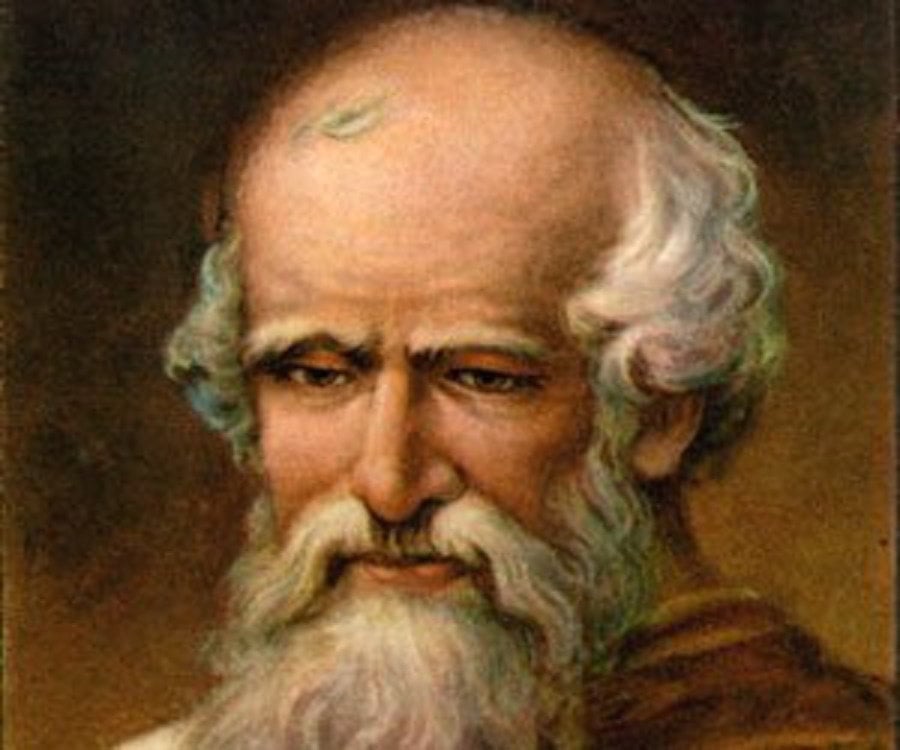
EUREKA
You all know the story of Archimedes, the famous Greek mathematician. After taking a bath, he suddenly got out and ran through the streets of Syracuse, shouting: “I found it, I found it!”
What did he find out? When he lowered himself in the bath, he suddenly realized, that the water rose, according to him slowly descending. This was not something at random, like swimming in a river. But it could me measured and this would happen according to a natural law. A low later named after him, which says, that the water level rises according to the volume, that is put in.
But why was Archimedes so ecstatic? He had found the solution to a major controversy in this harbortown in Southern-Italy. Syracuse was Greek and ruled by a couple of powerful families, who appointed a so-called “dictator”. There was a problem at his court. The Dictator had ordered a golden vessel for one of the temples in Syracuse. It was ordered from a famous goldsmith. When the vessel arrived, the dictator became suspicious. He suspected the goldsmith of cheating. Silver was less valuable and he thought that the golden vessel was largely of silver. But how to prove this.
Well, this is where Archimedes got in. Gold was heavier, than silver; so to reach the agreed weight, the volume would increase. So proving that the artist had stolen some gold. The Dictator's intuition proved right, the vessel contained silver. The story does not tell, what happened to the gold-smith. Archimedes was a practical man. His theoretical insights made it possible to develop all kinds of weapons. Syracuse was besieged by the Romans, but the Roman fleet could not approach the city walls. Under the supervision of this genius, in this respect surpassing Leonardo da Vinci., large mirrors were build, that set the sails on fire. Local historians describe cranes, that lifted the enemy ships out of the water.Some say he invented “Greek fire”, a chemical substance, that even burned on water.
But Romans never give up and in the end, Syracuse fell and the legionnaires looted the town. Archimedes was killed during this raid. A young soldier stabbed him. Because he did not want to be disturbed during his calculations.
Just a few notes of Archimedes survived, so it was a sensation, that a complete book surfaced. In a monastery, the monks ran out of parchment. They scraped off an old text (the one of the Greek mathematician) and turned it into a prayer book. Recently pecial X-ray-techniques made the original text visible. Once again his genius had endured time.
Another genius in the “Greek-timeframe” was Heron of Alexandria. He invented a steam engine. He used this power to open and close temple-doors, to move statues and to even make the Gods fly. It is, that he didnot put wheels under it. A railway from Alexandria to Jerusalem would have been possible.

Geen opmerkingen:
Een reactie posten